Project Overview
Needfinding is the synthesis of design thinking and qualitative research methods to discover people’s implicit and explicit needs in order to create innovative solutions. For this project, I worked with The Wick Lab to analyze their customer experience to find possible improvements.
The Wick Lab is a custom candle studio that focuses on the experience of creating a unique scent with essential oils to mix and pour your own candle.
Our Focus Question:
Why do first-time participants not return to The Wick Lab?
I answered this question through qualitative data collection, coming up with various recommendations to increase the rate of customer return.
Research Methods
Method 1: Observation
For this method, I observed a potential Wick Lab customer using their website to study customer reactions from the beginning of the process.
My goals during this observation were to better understand different types of users and how they interact with the site. Below are some of my main observations:
- The main video that triggers on the home screen is engaging and users stopped to watch some or all of it.
- The “About Us” page is very informative and gives users lots of information about the experience.
- Creating a reservation is very intuitive and easy to do
- The visuals on the website are very eye catching and make navigation easier.
Method 2: Interviewing
For my interview, I talked to a previous Wick Lab customer about her experience going to The Wick Lab. She went to The Wick Lab within the last six months, so it was a relatively recent experience for her. During the interview, I was trying to better understand her experience and answer my focus question of why she has not returned.
Interview Guide:
- Topic: Before the Experience
- Why did you choose to go to The Wick Lab?
- How did you find out about the wick lab?
- Topic: During the Experience
- Walk me through your experience, what were some highs and lows?
- Topic: After the Experience
- How did you feel once the experience was completed?
- What would encourage you to go to The Wick Lab again?
- Would you recommend The Wick Lab?
The themes that I saw in this interview were customer service, tangible experiences, and cost.
Cost is the theme that triggers the possibility of the other two themes. Customer service can affect the tangible experiences, and those experiences can affect the perception of service.
The customer service was largely positively mentioned, so improving tangible points of the experience could lead to return customers, as well as doing more promotions to slightly lower cost.
Method 3: Doing
For this method, I attended The Wick Lab with a group of friends in order to analyze the experience from the perspective of a customer. Overall, I found this experience to be very enjoyable. It had many highs and lows, but ultimately the end result made it worth it.
When we were smelling the candles along the wall, many of us commented on how difficult it was to actually smell the scents. Unless it was a very strong scent, it was difficult to pick out the scents which made it harder to decide what you wanted.
I also noticed that the journey is not guided at all (other than the instruction on how to do everything). It would have been nice to have some guidance on what smells to choose or how to know what to combine.
When mixing the oils, it was hard to tell what the finished candle would smell like, as you could only smell the most recent oil that was put into the mix. It would have been nice to have a toothpick or some tool to mix it up to get a better sense of the balance of smells.
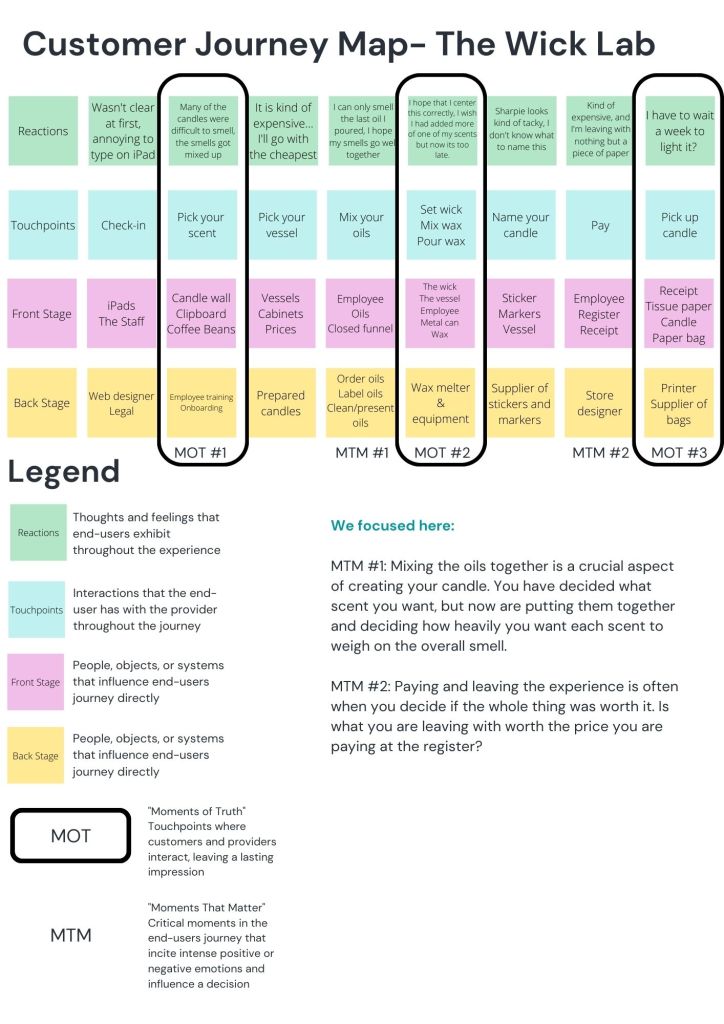
Leaving was anticlimactic, I would have enjoyed leaving with some kind of memorabilia. Below is a Customer Journey Map describing key touchpoints, contributors, and my reactions.
Method 4: “Graffiti Wall”
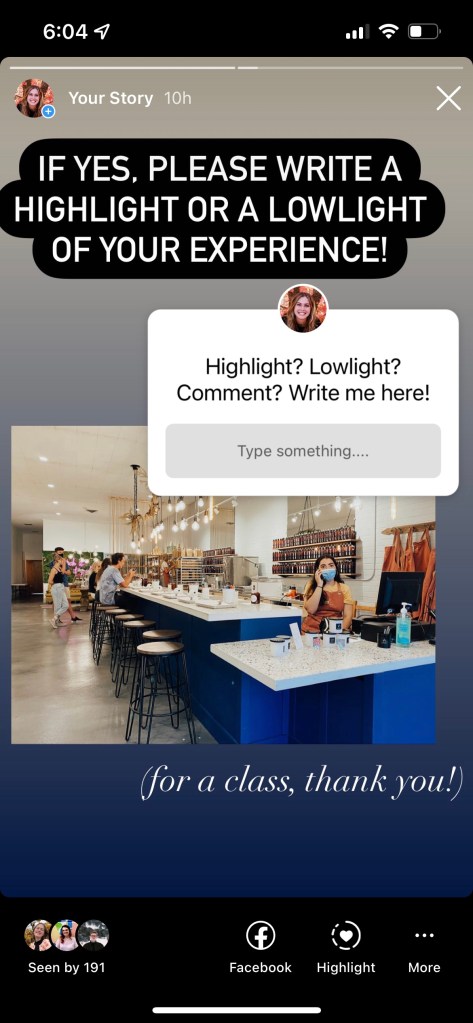
A “Graffiti Wall” is a method where you get a variety of past participants to give a thought or opinion on their experience in an anonymous way to get genuine reactions. I did this digitally by posting on my Instagram story asking people if they had been to The Wick Lab, and if so, what comments they had about their experience.

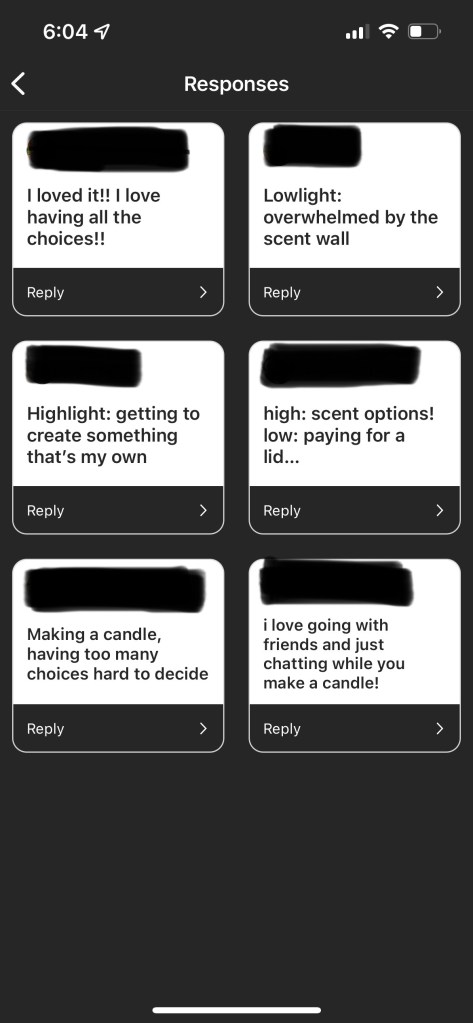
I received six responses to my story looking for graffiti wall responses. The responses are in the screenshot on the right (with usernames removed for privacy). Three people mentioned the amount of choices in their comment, but only one person mentioned it in a positive way.
Only one person mentioned building relationships as an aspect of the experience, which was interesting since through our interviews it appeared as though many people felt that relationship building was a major part of the experience.
Cost was only mentioned as a low by one person, and only in terms of having to buy a second lid. This was interesting because my assumption would have been that cost would have been a more frequently mentioned low.
From this data I found that while having many scent options is positive in that it creates many different options for the experience, it also can create an overwhelming feeling and become a negative. Creating a more guided journey could help this aspect.
I also discovered a customer need for personalization of the experience, which is a need that we hadn’t considered yet. Personalization creates much of the novelty of the experience, and if focused on more it could encourage repeat customers.
Recommendations
At this point, I worked with three other students who had completed similar research regarding this project. Together, we compared our findings to develop recommendations for The Wick Lab. As seen in the Customer Journey Map that I created after I completed the experience, we isolated two “Moments that Matter”, or moments that were vital in the end perception of the experience. We then found solutions to make these vitals moments a more positive experience, creating mock ROI equations to show the potential improvements these suggestions could create.
Moment that Matters #1: Mixing the Oils
Using the Design Thinking Process, we analyzed the moments that mattered by finding that a key moment of your experience at The Wick Lab. Mixing the oils is an element of the experience that really highlights co-creation.
When guests visit The Wick Lab they anticipate that mixing the oils and bringing your creative concoction to life would be a peak moment as taught in Chip Heath’s book “Power of Moments.” However, in participating in the experience, mixing the oils turned into a pit experience. Whether it was fighting a headache from the various scents, spilling oil all over your station, or being unsure what your candle will smell like in the end, mixing your oils was a pit moment for us as participants at The Wick Lab.
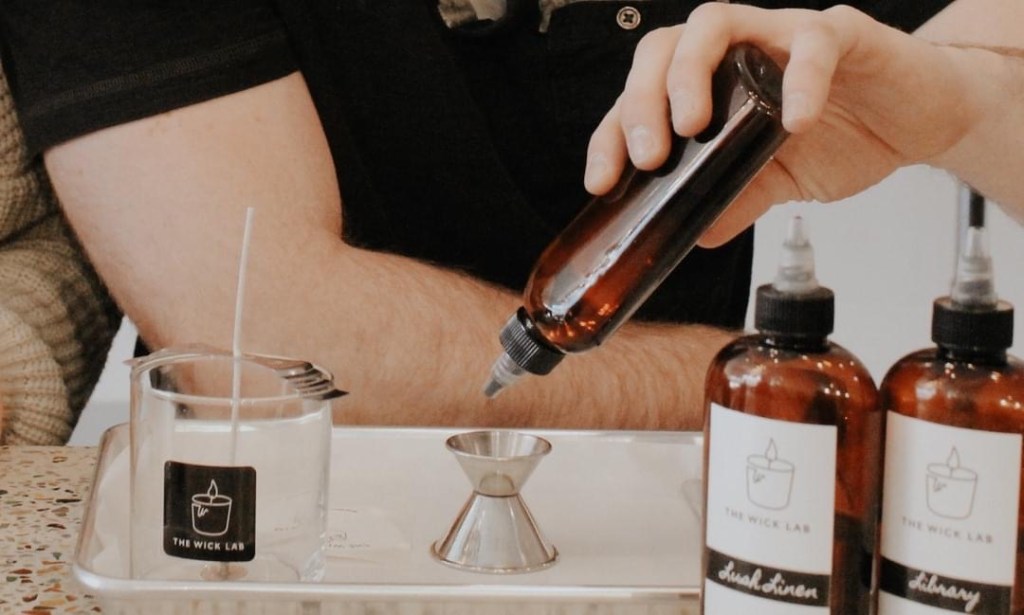
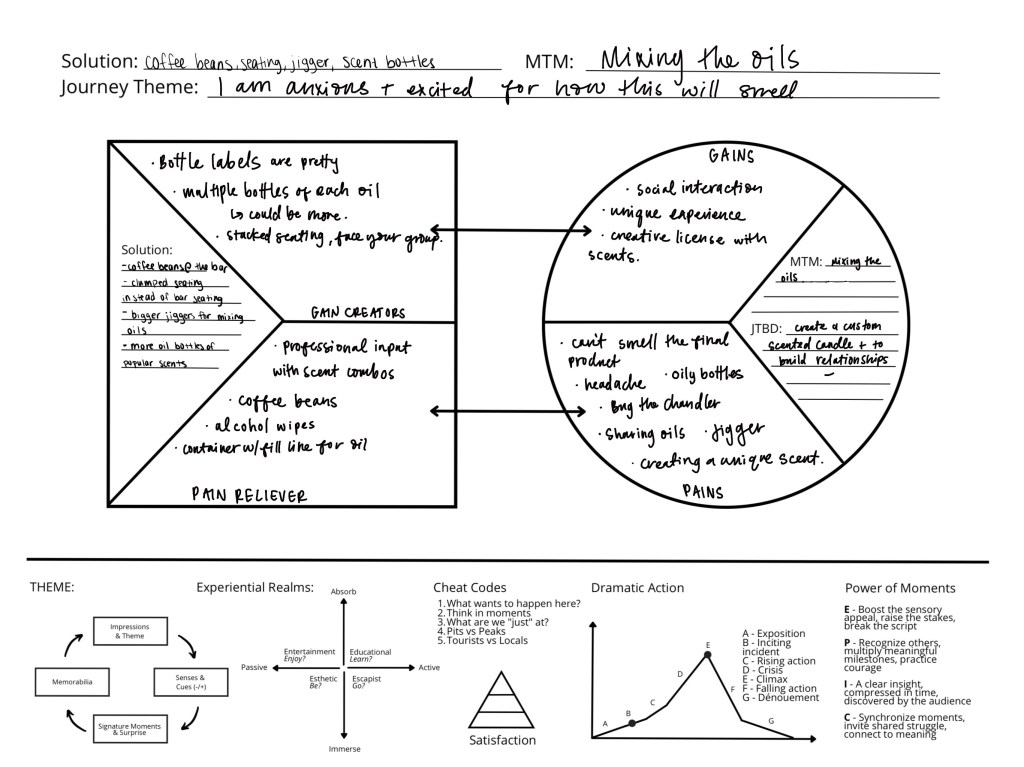
Following the ideation session, and after discussing the overarching themes experienced while mixing oils at The Wick Lab. The team concluded a list of a couple solutions following filling out the Value Proposition Canvas.
The pain point of mixing the oils and making combinations of scents to fully customize the candle and the candle experience could be solved by a couple of solutions:
- Coffee beans at the bar
- Clumped seating
- Bigger container for measuring the oils
- More bottles of popular oils (White Birch, Ocean Breeze, Vanilla)
We chose to analyze the Net Promoter Score (NPS) to illustrate the potential ROI for this specific MTM. In this case, we asked the question: “Based on your experience of mixing oils at The Wick Lab, how likely are you to recommend this to a friend on a scale of 1 to 10?”
From our data and asking individuals who have recently attended The Wick Lab, we found that the average NPS lies in the “detractor” range of 5.77. The detractor range begins with any number lower than seven, which shows how much room for improvement that The Wick Lab has, specifically in regards to the moment of mixing the oils. This proves just how important it is for The Wick Lab leadership to focus on this moment.
Moment that Matters #2: Paying
Using the Design Thinking Process, we analyzed the moments that mattered by finding that a key moment of the experience at The Wick Lab. Paying is an element of the experience that can easily become a huge sacrifice without much benefit, which can heavily color the perception of the experience.
The value equation is the perceived benefits – the perceived sacrifice. In the moment of paying, there is a lot of sacrifice on the end of the customer, with the only benefit in return being a receipt. In this situation, the sacrifice outweighs any benefits, which creates a moment of low value. This moment being the end of the in-store experience creates a low ending point (which can heavily affect the experience, according to the peak-end theory)


Following the ideation session, and after discussing the overarching themes experienced while paying at The Wick Lab. The team concluded a list of a couple solutions following filling out the Value Proposition Canvas.
The pain points of the payment process, the price paid, and leaving the store with nothing in hand other than a receipt could be solved by a couple of solutions:
- Online payment (through QR code or text)
- Rewards or discount programs to alleviate the high price point
- Leaving with some type of memorabilia alongside the receipt (ie, sticker, tea light candle, etc)
For this Moment that Matters, we chose to use the Customer Life Time Value (CLTV) formula to demonstrate the importance of the paying experience. These are the values that we used for The Wick Lab’s annual report:
- $100,000 Revenue
- 4,000 Candles Sold
- 3,000 People Purchased
- 2,000 Customers Lost
By using the CLTV formula, we found the value to be $50.66. Our goal with The Wick Lab is to decrease the number of customers lost. When that value gets decreased from 2,000 to 1,000, the CLTV increases significantly and doubles to $100.
Because of this analysis, we found that the paying MTM has a direct influence on the CLTV, therefore creating a need to hone in on the paying touchpoint and make it as meaningful and painless as possible.
 Madelyn Russell