Project Overview
This project was done as a group project in an experience insights course. In this group project, I completed all of the required Qualtrics analysis and contributed equally to the final report.
This project’s purpose was to collect data on our chosen drivers using a survey, and then to analyze that data to see if our chosen hypotheses were supported.
Our Drivers:
- RATER Service Quality Metrics (Reliance, Assurance, Tangible Features, Empathy, Responsiveness)
- Self-Determination Theory (Autonomy, Competence, Relatedness)
- NPS (Net Promoter Score)
- Enjoyment
Our Hypotheses:
- Autonomy, competence and relatedness are all contributing factors to the level of enjoyment for participants during the experience.
- The RATER service quality metrics directly relate to the likelihood of a participant to recommend an experience.
- Ordering food has a direct impact on the perception of service quality.
- The number of people who the respondent came with is related to the level of enjoyment.
Survey Method
Our team collected data from a sample of 101 Good Move Cafe customers. These customers all belong to the same cohort of the Experience Design Major at BYU, and thus are more familiar with the the scales and questions that were asked on the survey.
All visited the business over the course of the same one-week period. Immediately following their visit, the customers were asked to respond to a survey asking them to evaluate their experience at Good Move Cafe according to several different factors. Those responses were recorded and used to create the data for this report.
The survey included questions from multiple groups focusing on Good Move Cafe for their projects, but we analyzed only the questions involving our research focus.
Hypotheses Results
Hypothesis #1: Supported
Autonomy, competence and relatedness are all contributing factors to the level of enjoyment for participants during the experience.
Autonomy , competence, and relatedness are the three parts of self determination theory . Our hypothesis was that these three element s will directly correlate with the level of enjoyment participants experienced. The data supported our hypothesis, as there was a positive correlation to the different aspects of self determination theory and the enjoyment of the participant.
Autonomy was surveyed as “Doing it My Way ”, asking respondents the percentage of time that they felt they got to do the activity the way they wanted to. Autonomy was positively correlated with level of enjoyment , with a P-value of 0.000529.
Competence was surveyed as “ I Can Do This! ”, asking respondent s the percentage of time they felt they could do the activity well enough to be confident and not embarrassed. Competence was positively correlated with level of enjoyment, with a P-value of 0.0000102.
Relatedness was surveyed as “ I am Liked, I Fit In”, asking respondents how much they enjoyed being with the other participants . Relatedness was strongly positively correlated to level of enjoyment, with the most significant P-value of all three aspects of self determination theory at < 0.00001.
We decided to go a step further and put these variables into a regression analysis to see which had the most impact on the level of enjoyment. Overall , these variables had an R- squared value of 30.4%, meaning that 30.4% of the variable of enjoyment level can be explained by the variables in self determination theory . Relatedness contributed to 57% of that, competence 27%, and autonomy only 16%. These numbers tell us that while competence and autonomy are positively correlated with level of enjoyment, the only variable with statistical significance and the ability to affect level of enjoyment is relatedness .
Hypothesis #2: Supported
The service quality metrics directly relate to the likelihood of a participant to recommend an experience.
The RATER service quality metrics are a series of metrics designed to measure the perceived quality of service in the specific categories of reliability, assurance, tangible features, empathy, and responsiveness. Our hypothesis was that these metrics would relate to the likelihood of a participant to recommend the experience, also known as the Net Promoter Score (NPS).
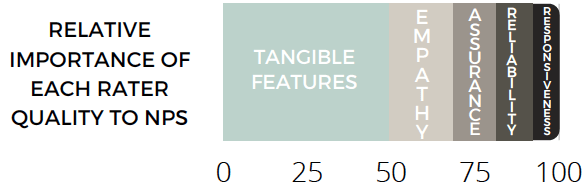
All five of the RATER metrics were positively correlated with the likelihood to recommend Good Move Cafe, all having a P-value of less than 0.05. Tangible features was the strongest correlated variable, with a P-value of < 0.00001 . We decided to look into these results further with a regression analysis. Overall, these variables had an R-squared value of 25.6%, meaning that 25.6% of the variable of NPS can be explained by the RATER service metrics. Tangible features contributed to 49% of this number, with the other service metrics each contributing to less than 20% of this number, and not being statistically significant. This means that the tangible service quality is most likely to affect the NPS variable.
Hypothesis #3: Not Supported
Ordering food has a direct impact on the perception of service quality.
To test this hypothesis that ordering food impacts perception of service quality, we ran correlations and a regression analysis to see if there was a correlation in the change of RATER score for each variable based on whether or not a respondent had ordered food. For all 5 variables of the RATER score, there was no significant relationship in service perception between those who did or did not order food.
Hypothesis #4: Supported
The number of people who the respondent came with is related to the level of enjoyment.
For this hypothesis, we measured the average level of enjoyment for each group size in the responses. Using a crosstab, we found that the average enjoyment score was significantly higher for respondents who participated in the experience with a group compared to those who went on their own.

Additional Insights
One of the most interesting insights we discovered after digging deeper into our data was the relationship between the likelihood to recommend Good Move Cafe and the condition of the games available. The responses showed that nearly 40% of guests ranked the condition of their games as “so-so” or “somewhat bad”. We also noticed that very few of these guests went on to give Good Move Café a positive NPS score.
Though our group was not originally interested in how game conditions could impact the experience of customers, the data showed that this variable was directly associated with the perceived quality of the experience and whether or not guests would recommend it to a friend.
Recommendations
Modifying Game Selection Process
Our study found that increased levels of autonomy increase the enjoyment of the Good Move experience. One of the key autonomous moments in this experience is the game selection process. However, because most guests come in groups, not every guest is able to participate in the game selection process (going to the game wall, perusing the options, bringing a game back to the table).
Exclusion from this key moment is likely to diminish the level of autonomy a customer experiences, thus diminishing their level of enjoyment.
Therefore, we would suggest the creation of a digital game menu that can be accessed via QR code at each of the tables. Doing so would allow more guests to participate in the selection of a game, while also adding a more accessible option for guests that are not able to make it over to the wall themselves.
Encourage Group Participation
One of the most compelling findings from our report was the fact that our guests were much likely to enjoy their experience at Good Move Cafe if they came with a group. In order to capitalize on this trend, Good Move Cafe should create more incentives for group participation. While there is already a monetary discount for groups, we suggest creating additional specials or offerings designed to promote group activity.
Improving Tangible Service Elements
Our data showed that customers really care about the tangible elements of the Good Move Experience. The tangibles most mentioned by customers were cleanliness of the restaurant and the condition of the board game, specifically the instructions.
In order to address these concerns, we suggest the staff implement a more rigorous cleaning process for the dining area and games. We also suggest that each set of game instructions be scanned and made available electronically via QR code.This change would remove customer’s exposure to one of the main elements contributing to the perception of poor tangibles.
 Madelyn Russell